Phase 1 · Supervised Learning
Algorithm #1
Regression
Linear Regression
The Best-Fit Line Finder — predicting continuous values by minimizing error.
What It Does
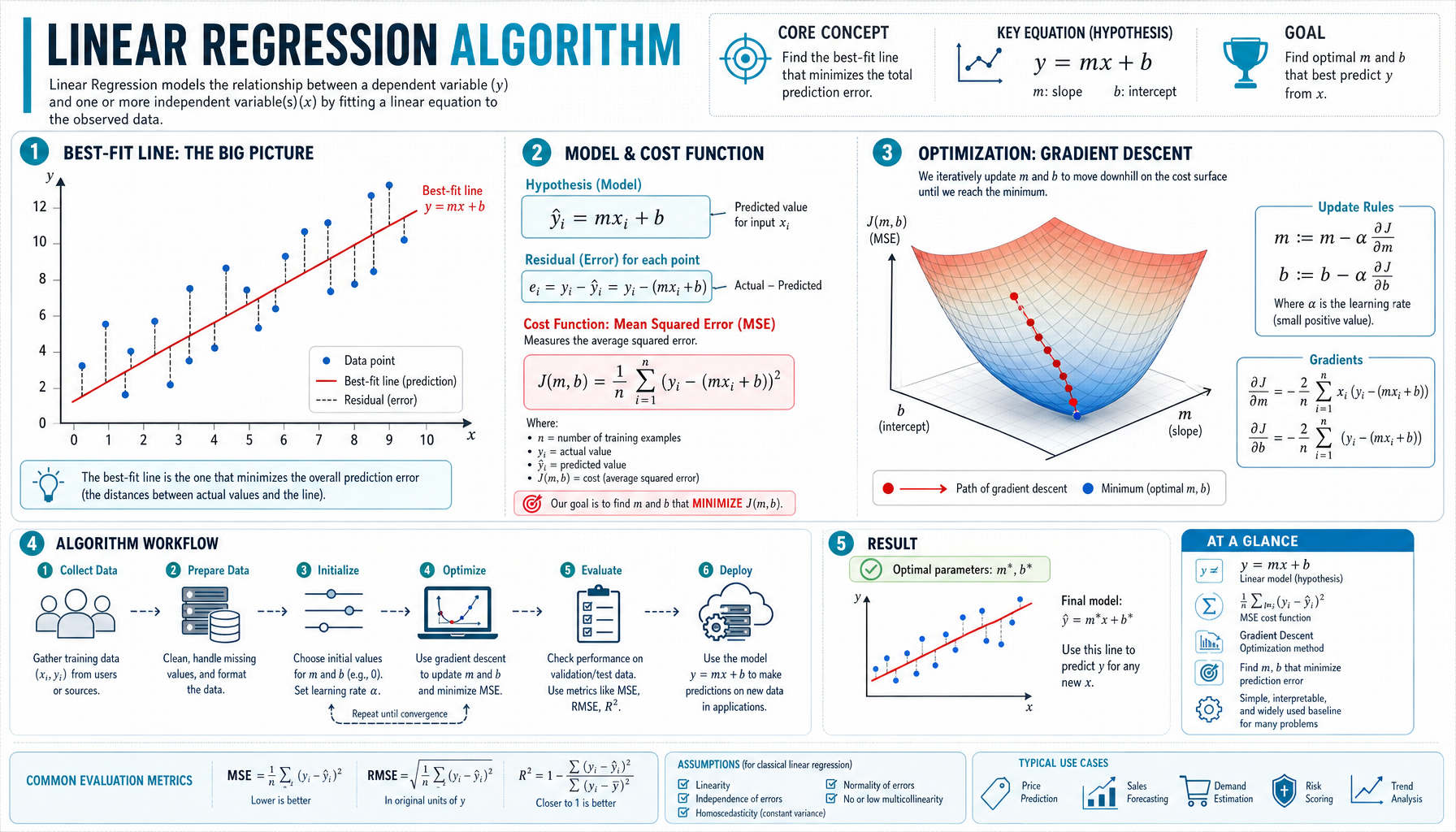
Linear Regression predicts continuous values (house prices, temperatures, sales figures) by
finding the best-fit line through your data points. Mental model: imagine stretching a rubber
band through scattered points — the band settles where it minimizes total distance from all points.
Input is features (x), output is a continuous prediction (y), and the goal is to minimize error.
Key Concepts
📉 Cost Function (MSE)
Mean Squared Error measures the average squared distance between predictions and actual values. Squaring penalizes large errors and keeps the math smooth & differentiable.
🧮 Normal Equation
θ = (XᵀX)⁻¹Xᵀy. An exact algebraic solution — one computation, done. Slow for large datasets (matrix inversion is expensive).
⬇️ Gradient Descent
Iterative: take small steps downhill on the cost function. Scales well to large datasets, but requires tuning the learning rate α.
⚖️ Feature Scaling
Features on different scales distort the cost function. Normalize to similar ranges (mean=0, std=1) for faster, more direct convergence.
How It Works
- Start with a linear hypothesis hθ(x) = θ₀ + θ₁x mapping features to a predicted value.
- Measure fit with the cost function — the summed squared distance between predictions and actual values.
- Choose a solver: the normal equation for a direct solution, or gradient descent for large datasets.
- Scale features first so gradient descent converges directly instead of zigzagging.
- Iterate (or solve) until θ minimizes the cost — you now have the best-fit line.
J(θ) = (1/2m) Σ(hθ(x⁽ⁱ⁾) − y⁽ⁱ⁾)² → θ := θ − α∇J(θ)
When to Use It
✅ Predicting continuous values
✅ Roughly linear relationships
✅ Need interpretable coefficients
✅ Baseline before complex models
❌ Categorical output → classifier
❌ Highly non-linear → polynomial/other
Checkpoint Questions
- Can you derive the normal equation from the cost function? (Hint: take the derivative of J(θ), set to zero, solve for θ.)
- Why minimize squared error instead of absolute error? (Hint: think about differentiability and outlier sensitivity.)
- What happens when features aren't scaled? (Hint: visualize the cost function contours.)