Algorithm #4
Random Forest 🌲
Ensemble Learning · Phase 1
🌲🌲🌲
Random
Forest
Forest
🧍
Tree 1
🧍
Tree 2
🧍
Tree 3
🧍
Tree 4
🧍
Tree 5
🧍
Tree 6
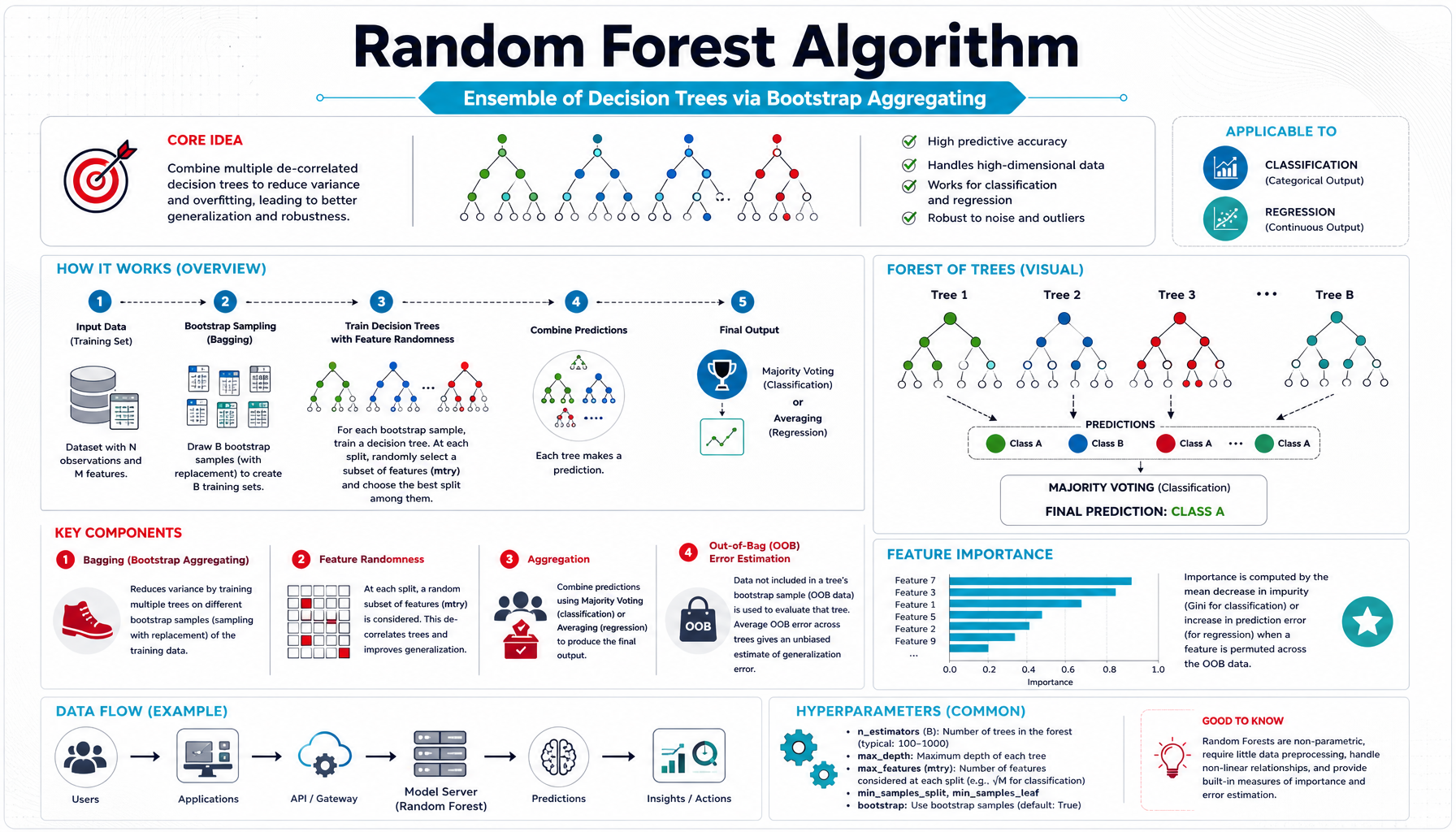
How It Works ✨
📊 Data
→
🎲 Bootstrap
→
🌲 Trees
→
🗳️ Vote
→
✅ Result
🎲 Bagging
Each tree trains on a random sample of the data (with replacement). This creates diversity among trees!
👁️ Feature Randomness
Each split considers only a random subset of features. This prevents trees from all making the same mistakes.
🗳️ Voting Mechanism
For classification: majority vote wins. For regression: average all predictions. Democracy of trees!
🎯 Wisdom of Crowds
Many weak learners become one strong learner. Individual trees may overfit, but the ensemble stays robust!
🔧 Key Parameters
•
n_estimators — Number of trees in the forest (more trees = more stable)
•
max_features — Number of features to consider at each split
•
max_depth — Maximum depth of each tree (controls overfitting)⚖️ Bias-Variance Tradeoff
🌴
Single Tree
(High Variance)
(High Variance)
⚖️
🌲🌲🌲
Random Forest
(Balanced!)
(Balanced!)
Ensemble reduces variance without increasing bias