Phase 5 · Reinforcement Learning
SARSA
On-Policy Temporal-Difference Control
🎯 Core Concept
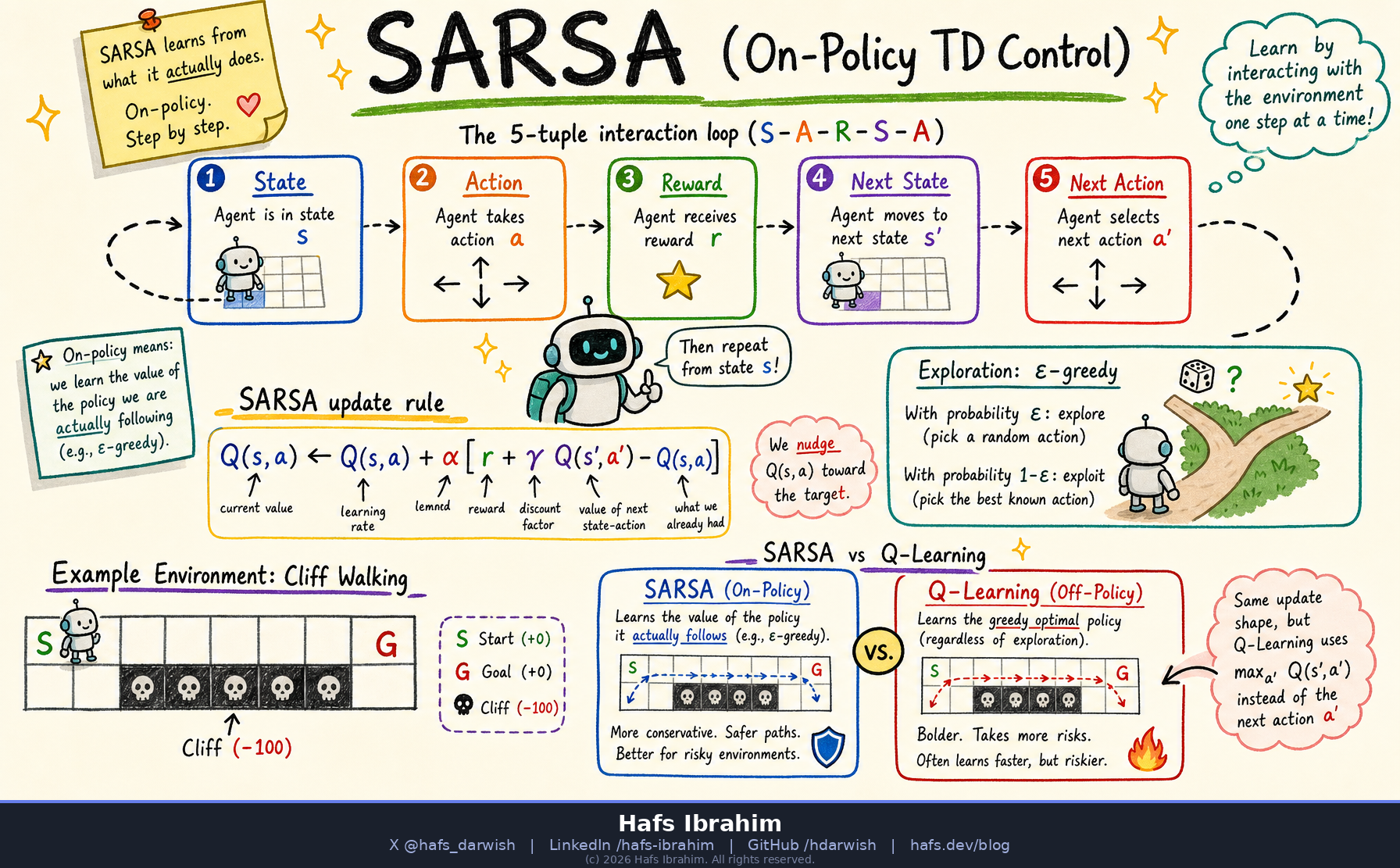
SARSA learns an action-value function Q(s, a) by bootstrapping from the
transition it actually experiences. Its name is literally the tuple it uses to
update: State → Action → Reward → next State →
next Action. Because the update uses the action the agent will really take next,
SARSA is on-policy: it evaluates and improves the very policy it follows, exploration included.
Mental model: the cautious hiker. SARSA learns the value of the path it walks
— including its own risky wanderings — so it prefers routes that stay safe
even while exploring. Q-Learning, by contrast, dreams of the perfect path it might take if it never slipped.
🔑 Key Components
The SARSA quintuple
(s, a, r, s', a') — the update needs the next action a' chosen by the current policy, not the max over actions.
TD update rule
Move Q(s,a) a step toward the observed reward plus the discounted value of the next state-action actually chosen.
ε-greedy exploration
Mostly pick the greedy action; with probability ε roll the dice and explore. That exploration is baked into what SARSA learns.
α and γ
Learning rate α sets step size; discount γ weighs future rewards. Both shape stability and horizon.
⚙️ How It Works
Q(s,a) ← Q(s,a) + α [ r + γ·Q(s',a') − Q(s,a) ]
- Observe state s; choose action a via ε-greedy on Q.
- Take a, receive reward r, land in next state s'.
- Choose next action a' — again via ε-greedy (this is the on-policy part).
- Update Q(s,a) toward the TD target r + γ·Q(s',a').
- Set s ← s', a ← a' and repeat until the episode ends.
SARSA (on-policy)
Learns value of the policy it follows. Accounts for exploration risk → safer, more conservative paths (walks away from the cliff edge).Q-Learning (off-policy)
Uses max over next actions. Learns the greedy optimum regardless of exploration → bolder paths (hugs the cliff).🌎 Real-World Applications
Robot navigation
Safe autonomous control
Traffic signal control
Game-playing agents
Adaptive routing
Energy management
🧪 Checkpoint Questions
1. Why is SARSA called “on-policy” while Q-Learning is “off-policy”?
Hint: look at which next action enters the update — the one actually taken, or the greedy best?
2. In the cliff-walking problem, why does SARSA choose the longer, safer route while Q-Learning walks the cliff edge?
Hint: think about whose exploration risk gets folded into each algorithm's learned values.
3. What happens to SARSA's learned policy as ε is annealed toward 0 over training?
Hint: consider how the followed policy and the target policy converge as exploration fades.