Algorithm #18
Phase 5 · Reinforcement Learning
Deep RL
Deep Q-Network (DQN)
Q-learning meets deep neural networks — learning to act from raw high-dimensional states.
🎯 Core Concept
Tabular Q-learning stores one value per (state, action) pair — impossible when states are
game pixels or continuous sensors. DQN replaces the Q-table with a neural network that
approximates Q(s,a), letting an agent learn optimal policies in vast state spaces.
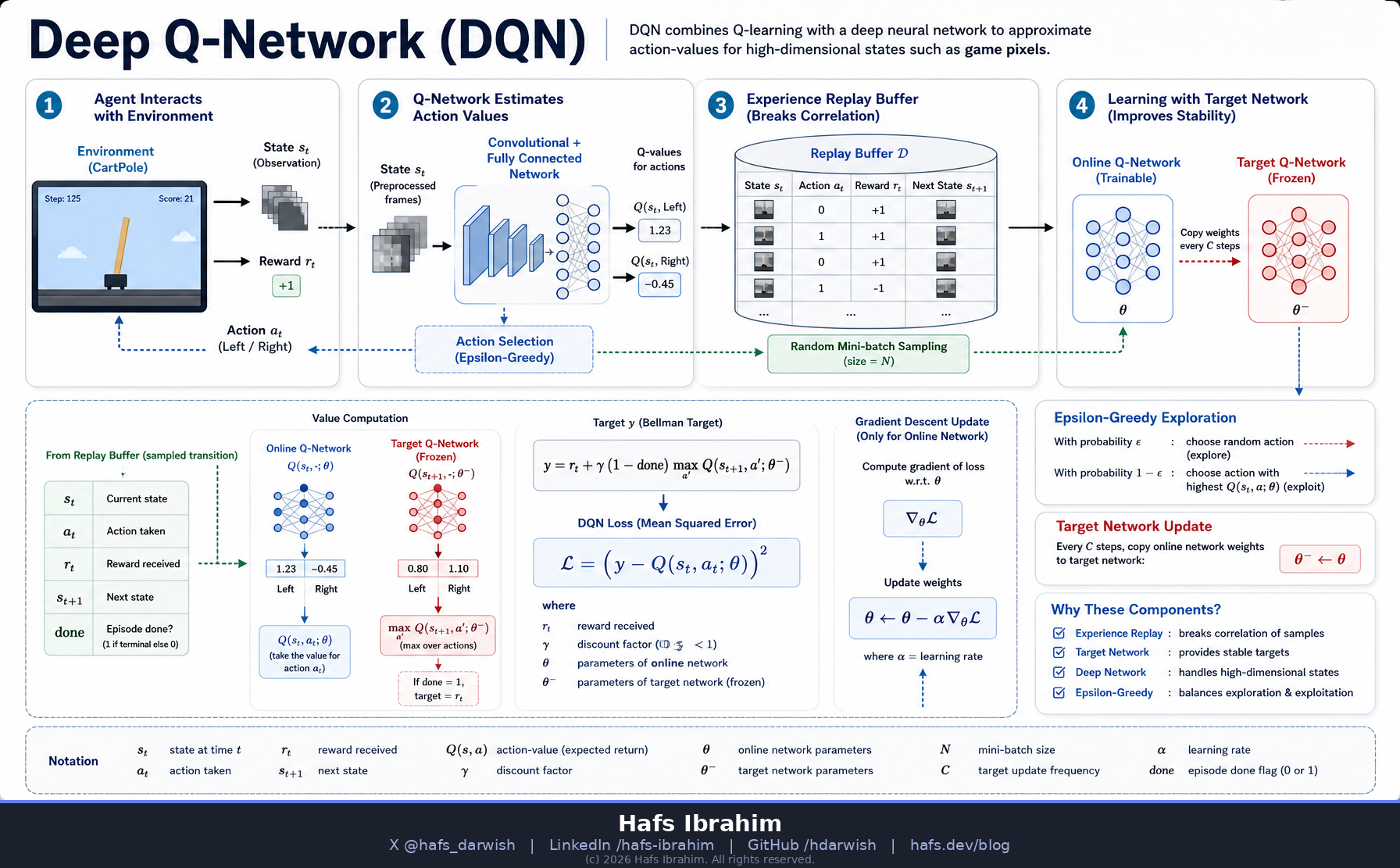
Two tricks tame the instability of mixing bootstrapping, function approximation, and
off-policy learning: an experience replay buffer and a target network.
Mental model: A student (online network) practicing against a
slowly-updated answer key (target network), reviewing a shuffled deck of past
experiences (replay buffer) instead of only the last move — so lessons don't
chase their own tail.
🔑 Key Components
1. Function Approximation
A neural net maps state → Q-value for every action. Generalizes to unseen states instead of needing a lookup entry for each one.2. Experience Replay
Store transitions (s, a, r, s′) in a buffer; train on random minibatches. Breaks temporal correlation and reuses data efficiently.3. Target Network
A periodically-frozen copy of the Q-net supplies the TD target. Fixing it stops the target from moving every step, which would otherwise diverge.4. ε-Greedy Exploration
With probability ε act randomly, else greedily. ε decays over time — explore early, exploit once Q-estimates sharpen.⚙️ How It Works
- Observe state s; pick action a via ε-greedy over the online Q-net's outputs.
- Execute a, receive reward r and next state s′; store (s, a, r, s′) in the replay buffer.
- Sample a random minibatch of transitions from the buffer.
- Compute the TD target using the frozen target network, then minimize the squared error below by gradient descent on the online network.
- Every N steps, copy the online weights into the target network. Decay ε. Repeat.
L(θ) = ≈ [ ( r + γ · maxa′ Q(s′, a′; θ−) − Q(s, a; θ) )2 ]
🌎 Real-World Applications
Atari & game AI — the original DQN reached human-level play on dozens of Atari games from pixels alone.
Robotics & control — discrete-action control tasks like grasping, navigation, and balancing.
Resource management — datacenter cooling, energy scheduling, network routing decisions.
Recommendation & ads — sequential decision problems framed as maximizing long-term engagement reward.
🧪 Checkpoint Questions
1. Why does DQN need experience replay rather than learning from consecutive transitions?
(Hint: consecutive samples are highly correlated — what does that do to gradient estimates and stability?)
2. What specific instability does the target network solve, and what would go wrong without it?
(Hint: the TD target depends on the same weights you're updating — think "chasing a moving target".)
3. DQN is off-policy. How does that let experience replay work at all, and why couldn't on-policy SARSA reuse an old buffer the same way?
(Hint: compare the max over next actions in the target vs. learning from the action actually taken.)
StreakDay 19
Phase 560%
Curriculum18 / 30