Phase 5 · Reinforcement Learning · Algorithm 19 / 30
Policy Gradient — REINFORCE
Learn the policy directly, not the value of states.
🎯 Daily Micro-Learning Card
📜 Core Concept
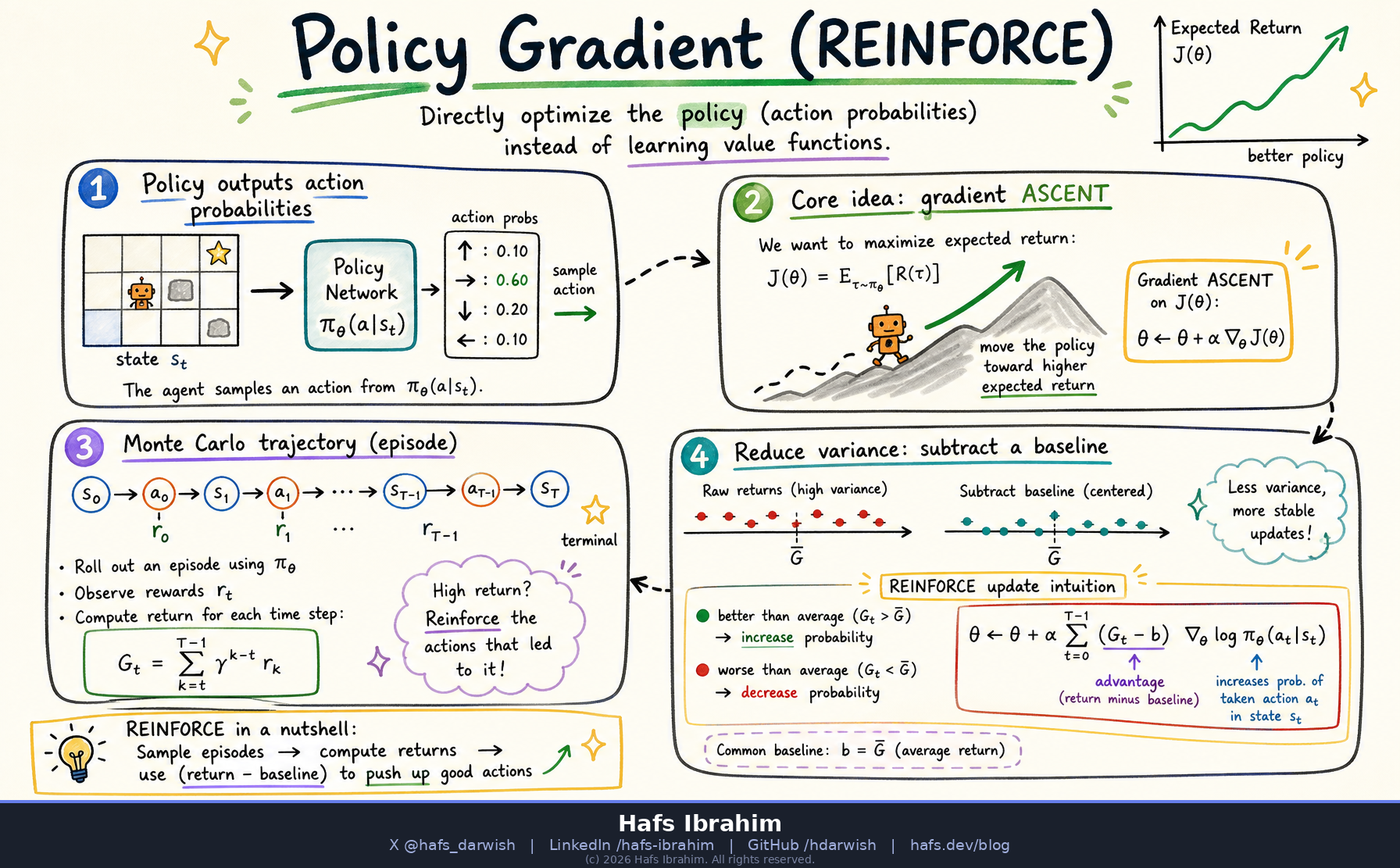
Instead of learning how good each state/action is (value-based methods like Q-learning) and then acting greedily, policy gradient methods parameterize the policy itself — a network that outputs a probability distribution over actions — and nudge those probabilities up for actions that led to high return and down for actions that led to low return. You climb the expected-reward hill by gradient ascent.
∇θ J ≈ Σt ∇θ log πθ(at|st) · (Gt − b)
reinforce action probability, weighted by return minus a baseline
reinforce action probability, weighted by return minus a baseline
Mental model: “Try, then turn up the volume on what worked.” Play a full episode, see the total reward, and make the good moves more likely next time — in proportion to how good the outcome was.
🔑 Key Components
Parameterized Policy πθ
A network mapping state → action probabilities. Differentiable, so we can push gradients through it.
Expected Return J(θ)
The objective we maximize: average total reward the policy earns over episodes.
Monte Carlo Rollout
Sample a full trajectory, compute the actual return Gt — no bootstrapping, unbiased but noisy.
Baseline b
Subtract a reference (e.g. average return) to cut variance without adding bias.
⚙️ How It Works (REINFORCE)
Run the current policy
πθ for a full episode, recording states, actions, and rewards.Compute the return
Gt = discounted sum of rewards from each timestep to the end.Subtract a baseline
b to center the returns and shrink gradient variance.Update:
θ ← θ + α Σ ∇ log π(a|s)(Gt−b) — gradient ascent toward more reward.Repeat across many episodes; probabilities of high-return actions steadily rise.
🌎 Real-World Applications
Robotics control
Continuous action spaces
Game-playing agents
LLM alignment (RLHF/PPO roots)
Resource scheduling
Portfolio/trading policies
🧪 Checkpoint Questions
1. Why optimize the policy directly instead of learning Q-values first?
Hint: think about continuous or high-dimensional action spaces where argmax over Q is intractable, and about learning stochastic policies.
2. How does subtracting a baseline reduce variance without introducing bias?
Hint: the expected value of ∇ log π times a constant baseline is zero — it re-centers the reward signal but leaves the gradient's mean unchanged.
3. Why is vanilla REINFORCE high-variance, and what makes it slow to converge?
Hint: it uses full Monte Carlo returns from noisy single trajectories — one lucky/unlucky episode swings the whole update. This motivates Actor-Critic (next up).