Phase 5 · Reinforcement Learning
Algorithm #20
Policy + Value
Actor-Critic
Two learners, one loop — a policy that acts and a value function that judges.
Core Concept
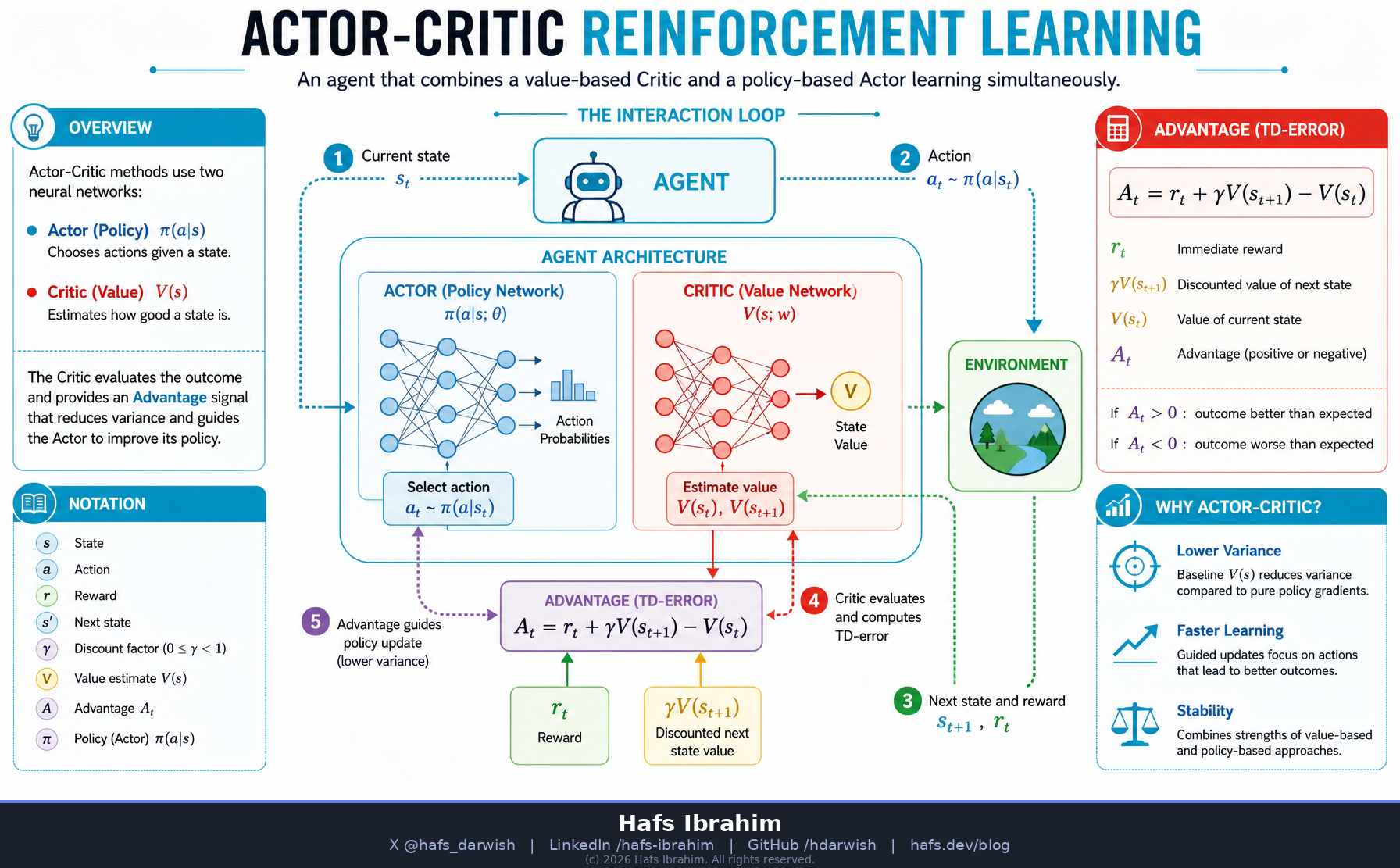
Actor-Critic fuses the two great families of reinforcement learning. The Actor is a policy
that decides which action to take; the Critic is a value function that estimates how good
the current situation is. The Critic evaluates each move and hands the Actor a low-variance learning
signal — the advantage — telling it whether the action was better or worse than expected.
This pairing keeps the sample-efficiency of value methods and the flexibility of policy methods.
Key Components
🎭 Actor (Policy Network)
Maps states to a distribution over actions. Updated in the direction the Critic says is advantageous.
⚖️ Critic (Value Network)
Estimates V(s) — expected return from a state. Learns by minimizing TD-error.
📈 Advantage Function
A(s,a) = Q(s,a) − V(s). How much better an action was than the baseline. Guides Actor updates.
🎯 Variance Reduction
The value baseline shrinks the noisy gradient of pure policy methods, stabilizing learning.
How It Works
- Actor observes state s and samples an action a from its policy π(a|s).
- Environment returns reward r and next state s′.
- Critic computes the TD-error / advantage from what actually happened vs. its prediction.
- Critic updates V(s) to reduce that error; Actor nudges π toward actions with positive advantage.
- Loop repeats — the two networks co-adapt until the policy is near-optimal.
A(s,a) = r + γ·V(s′) − V(s) → ∇θ log π(a|s) · A(s,a)
Real-World Applications
🤖 Robotic locomotion & control
🎮 Game AI (A2C / A3C)
🚗 Autonomous driving policies
💬 RLHF for language models
📦 Resource scheduling
Checkpoint Questions
- What is the specific job of the Critic, and how does its signal help the Actor improve?
- Why does subtracting a value baseline (using the advantage) reduce variance compared to pure policy gradient?
- Write the advantage estimate using the one-step TD-error. What does each term represent?