PHASE 6 · DEEP LEARNING · ALGORITHM 25 / 30
Transformer
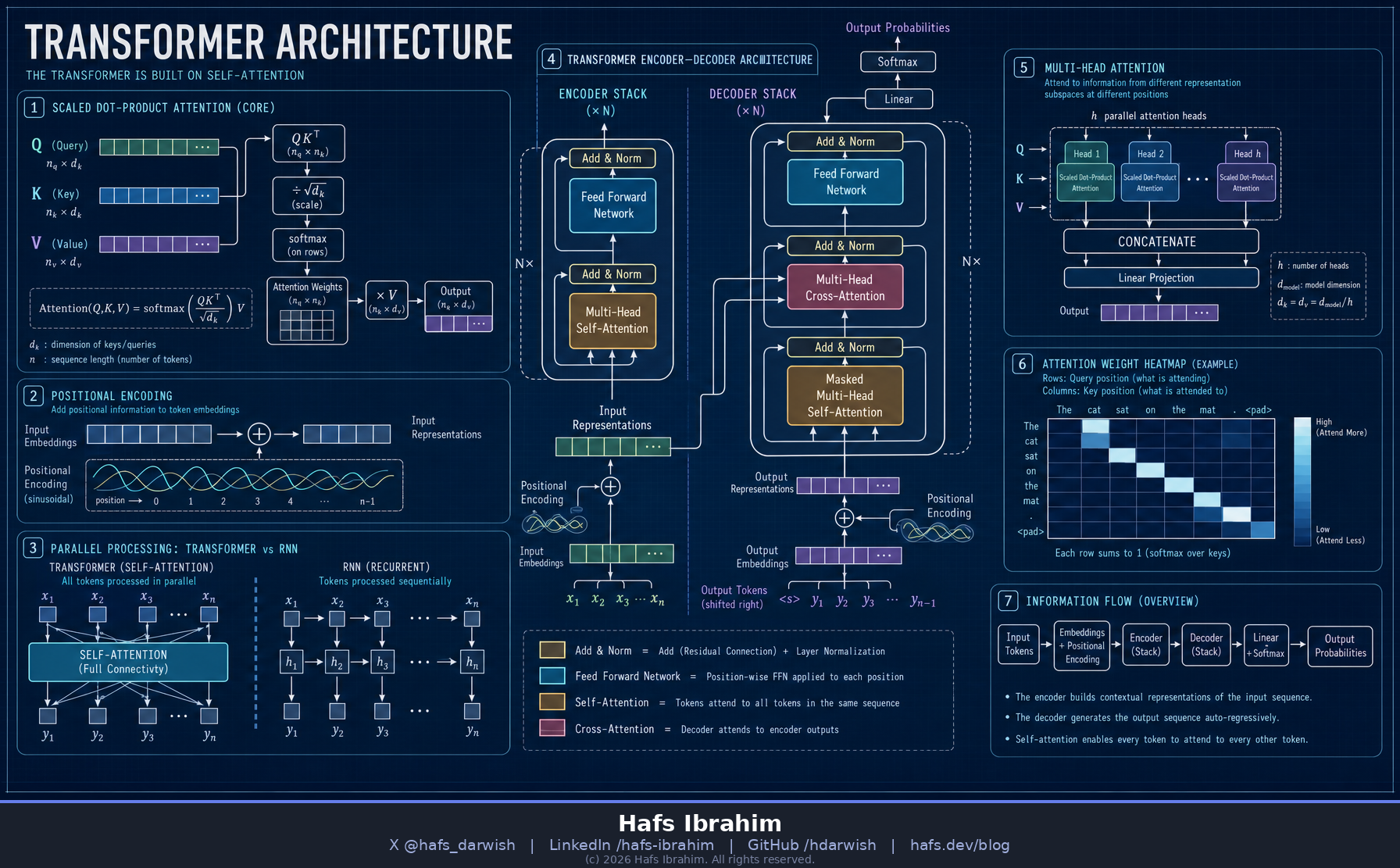
Attention is all you need — parallel sequence modeling
💡Core Concept
The Transformer replaces recurrence with self-attention: every token looks at every other token in one parallel pass and decides how much to weigh each. No sequential loop means the whole sequence is processed at once, so long-range dependencies are captured directly and training scales across GPUs. It is the architecture behind modern LLMs.
🧩Key Components
Self-Attention
Each token forms Query, Key, Value vectors; attention scores decide what to focus on.
Multi-Head Attention
Several attention heads run in parallel, each learning a different relationship, then concatenated.
Positional Encoding
Sinusoidal signals injected into embeddings so the model knows token order without recurrence.
Encoder–Decoder
Stacked blocks of attention + feed-forward layers with residual connections and layer norm.
⚙️How It Works
Embed tokens and add positional encodings so order is preserved.
Project each token into Query (Q), Key (K), and Value (V) vectors.
Score how much each token attends to others via scaled dot-product.
Softmax the scores and take a weighted sum of the Values.
Run multiple heads in parallel, concat, then feed-forward + residual/norm.
Attention(Q,K,V) = softmax( Q·Kᵀ / √dₖ ) · V
🌎Real-World Applications
- Large language models (GPT, Claude, Llama) — text generation & reasoning
- Machine translation and summarization
- Vision Transformers (ViT) for image classification
- Protein structure prediction (AlphaFold's attention blocks)
- Speech recognition and audio modeling
❓Checkpoint Questions
1. What is self-attention, and how do Query, Key, and Value vectors produce an attention weight?
2. Why are Transformers better than RNNs for long sequences? (Think parallelism and gradient path length.)
3. Why do we need positional encoding at all, when RNNs got order "for free"?