PHASE 7 · ALGORITHM 29 / 40
Markov Decision Process (MDP)
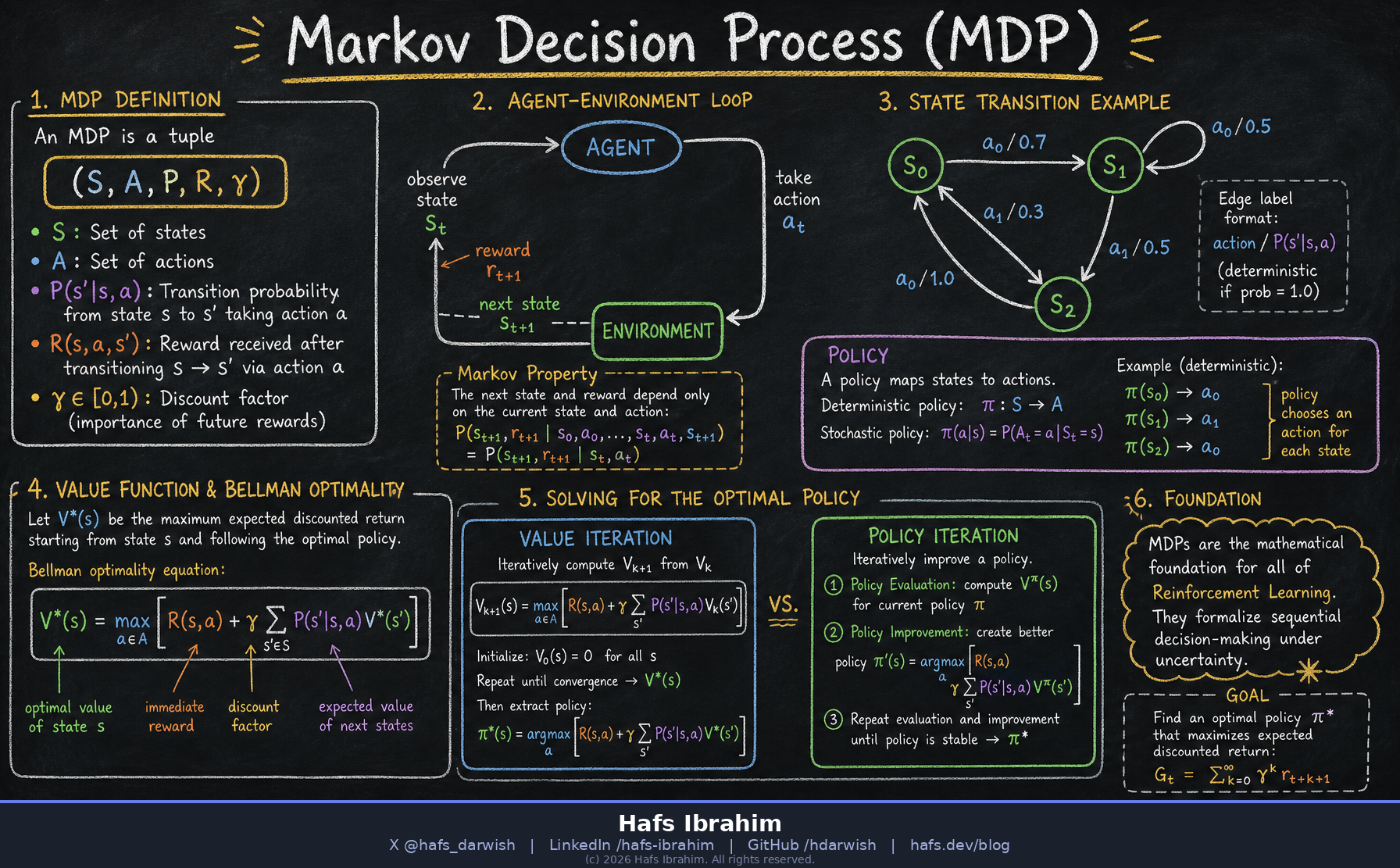
The mathematical grammar of sequential decision-making — the foundation beneath all reinforcement learning.
Core Concept
An MDP is a formal model for making a sequence of decisions in an uncertain world. At each step, an agent sees a state, chooses an action, and the environment responds with a reward and a new state. The "Markov" property means the future depends only on the present state, not the full history. Solving an MDP means finding the policy that maximizes long-run reward.
Key Components
States & Actions (S, A)
The situations the agent can be in, and the choices available in each.Transition P(s′|s,a)
The probability of landing in state s′ after taking action a in state s.Reward R & Discount γ
Immediate feedback for each step; γ (0–1) weights future vs. present reward.Policy π & Value V
π maps states→actions; V(s) is the expected total reward from state s onward.How It Works
- Define the tuple (S, A, P, R, γ) that describes your problem.
- The agent follows a policy π: observe state → pick action → get reward + next state.
- Evaluate each state's worth with the Bellman equation, which links a state's value to its successors' values.
- Improve the policy by acting greedily on those values — repeat until it stops changing.
- This loop is value iteration / policy iteration: dynamic programming that converges to the optimal policy π*.
Bellman optimality:
V*(s) = maxa [ R(s,a) + γ · Σs′ P(s′|s,a) · V*(s′) ]
Optimal policy: π*(s) = argmaxa [ R(s,a) + γ · Σs′ P(s′|s,a) · V*(s′) ]
V*(s) = maxa [ R(s,a) + γ · Σs′ P(s′|s,a) · V*(s′) ]
Optimal policy: π*(s) = argmaxa [ R(s,a) + γ · Σs′ P(s′|s,a) · V*(s′) ]
Real-World Applications
🤖 Robotics & motion planning
🎮 Game-playing agents (RL)
📦 Inventory & supply chains
💊 Treatment-decision policies
🚗 Autonomous navigation
📈 Portfolio & resource allocation
Checkpoint Questions
- What is a policy, and what does the value function represent about a state?
- Why does the discount factor γ matter — what changes as γ moves from near 0 toward 1?
- In plain words, what is the Bellman equation saying about how a state's value relates to its neighbors?