Generative Adversarial Networks (GANs)
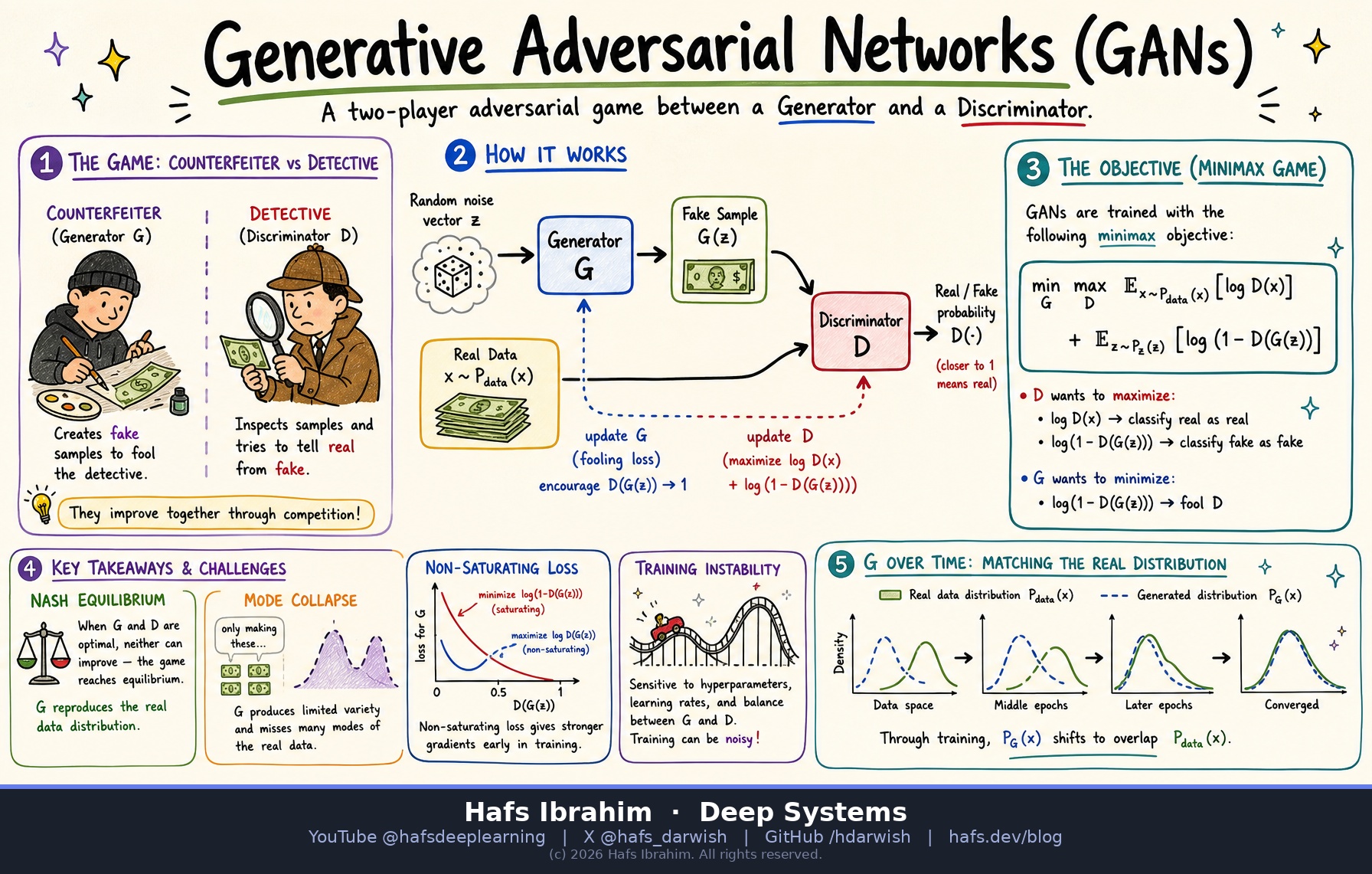
Educational hand-drawn sketchnote explaining Generative Adversarial Networks as a two-player adversarial game. Center: a large loop diagram — random noise vector z (small dice/scribble cloud) feeding a Generator box G that outputs a Fake Sample, alongside a Real Data stack; both arrows converge into a Discriminator box D that outputs a Real/Fake probability, with two dotted backward gradient arrows labeled 'update D' and 'update G (fooling loss)'. Left panel: the counterfeiter-vs-detective metaphor drawn as two simple figures, one painting a forged note, one inspecting it with a magnifier. Right panel: the minimax objective written clearly: min_G max_D E[log D(x)] + E[log(1 - D(G(z)))]. Bottom strip: four small labeled callouts — Nash equilibrium, mode collapse, non-saturating loss, training instability. Include a small plot showing the generated distribution shifting to overlap the real data distribution over epochs. Warm cream background, marker lettering, clear legible labels.