Attention Mechanisms
Let every position look back at every other position — and weight what actually matters.
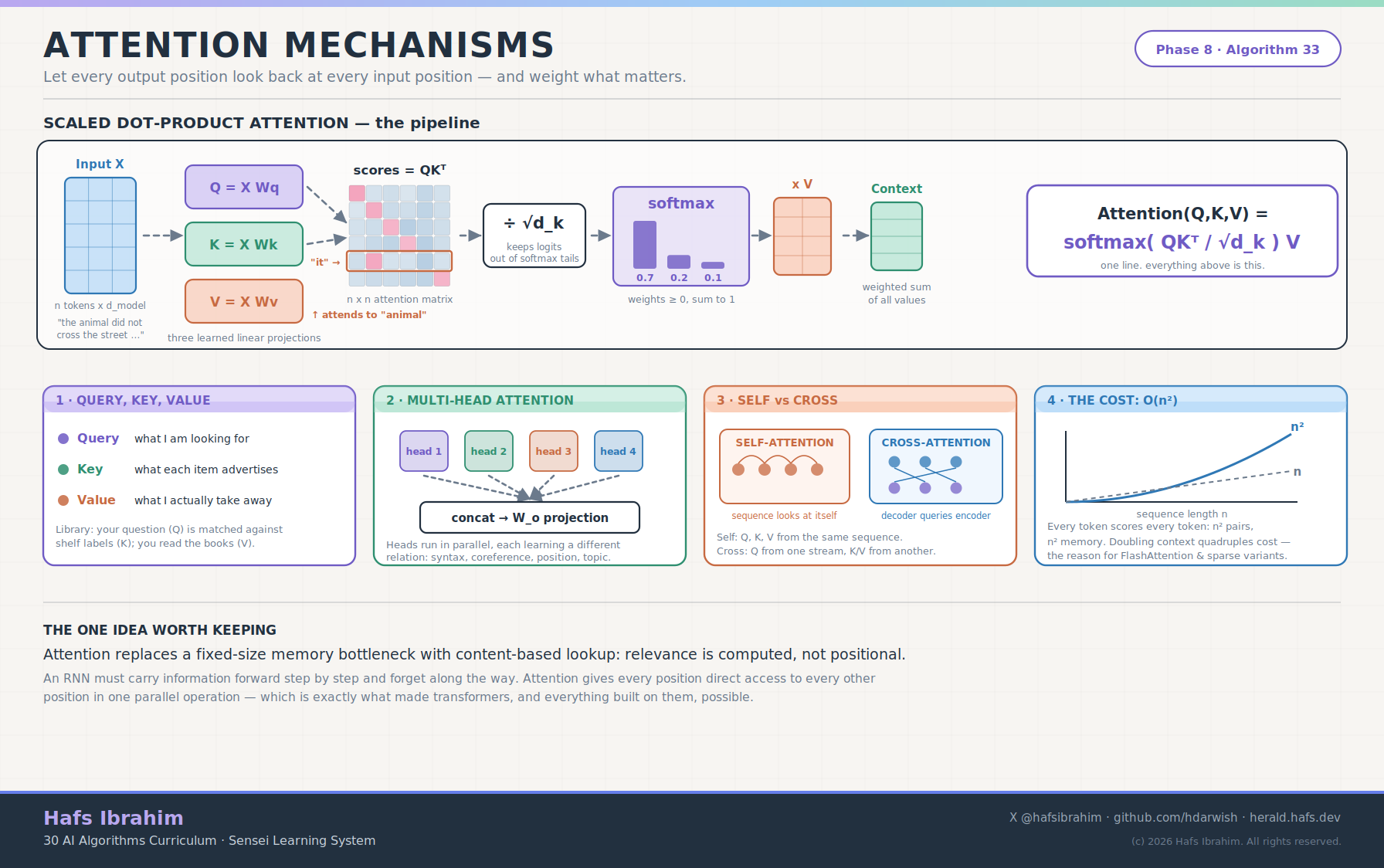
Scaled dot‑product attention, end to end — plus the three things people get wrong about it.
The core idea
Before attention, a sequence model had to squeeze everything it had read into one fixed-size hidden state and carry it forward. Information decayed. Long-range links were lost.
Attention throws that bottleneck out. Instead of remembering, each position looks up what it needs, directly, from every other position — in a single parallel operation. Relevance stops being a function of distance and becomes a function of content.
Query, Key, Value
All three are just learned linear projections of the same input: Q = XWq, K = XWk, V = XWv. The model learns how to ask, how to advertise, and what to hand over as three separate skills.
The whole mechanism in one line
- QKT — dot every query against every key. Similar directions score high. Result: an n×n compatibility matrix.
- ÷ √dk — without this, dot products grow with dimension, softmax saturates, and gradients vanish. One divide fixes a real training failure.
- softmax — turn raw scores into a probability distribution over positions: non-negative, sums to one. Now they are usable weights.
- × V — take the weighted average of the values. High-attention positions dominate the output; the rest fade.
Three things worth internalising
Multi-head is not redundancy
Split dmodel into h smaller subspaces, run attention independently in each, concatenate, project with Wo. Different heads reliably specialise — syntactic dependency, coreference, positional locality. One head can only express one relation per position; eight can express eight.
Self vs cross is only about where Q comes from
Self-attention: Q, K, V all from the same sequence — the sequence interrogating itself. Cross-attention: Q from one stream, K and V from another — a decoder querying an encoder. Translation, captioning, and retrieval-augmented models all live in that second case.
The cost is quadratic, and that shapes the field
Every token scores every token: n² computations, n² memory for the score matrix. Doubling context length quadruples both. Essentially all of modern long-context work — FlashAttention, sparse and sliding-window patterns, linear-attention families — is an attack on that one exponent.
Today's practice
Implement it from scratch — 30 minutes
- Write
scaled_dot_product_attention(Q, K, V, mask=None)in NumPy. No frameworks. Shapes: (n, dk) in, (n, dv) out. - Assert every output row of the softmax sums to 1.0. If it doesn't, you softmaxed the wrong axis — the most common bug in this code.
- Delete the
√dkscaling and set dk=512. Print the max softmax weight. Watch it collapse toward 1.0 — that is saturation, felt rather than read. - Add a causal mask (upper triangle to −∞) and confirm position i attends only to j ≤ i.
- Feed a real sentence's embeddings and print the attention matrix as a heatmap. Find one row where the peak is linguistically sensible.
Why does attention need three projections rather than two? Specifically: what breaks if you set V = K and reuse the keys as the values?