CAP Theorem
The law that decides what your database is allowed to promise when the network breaks.
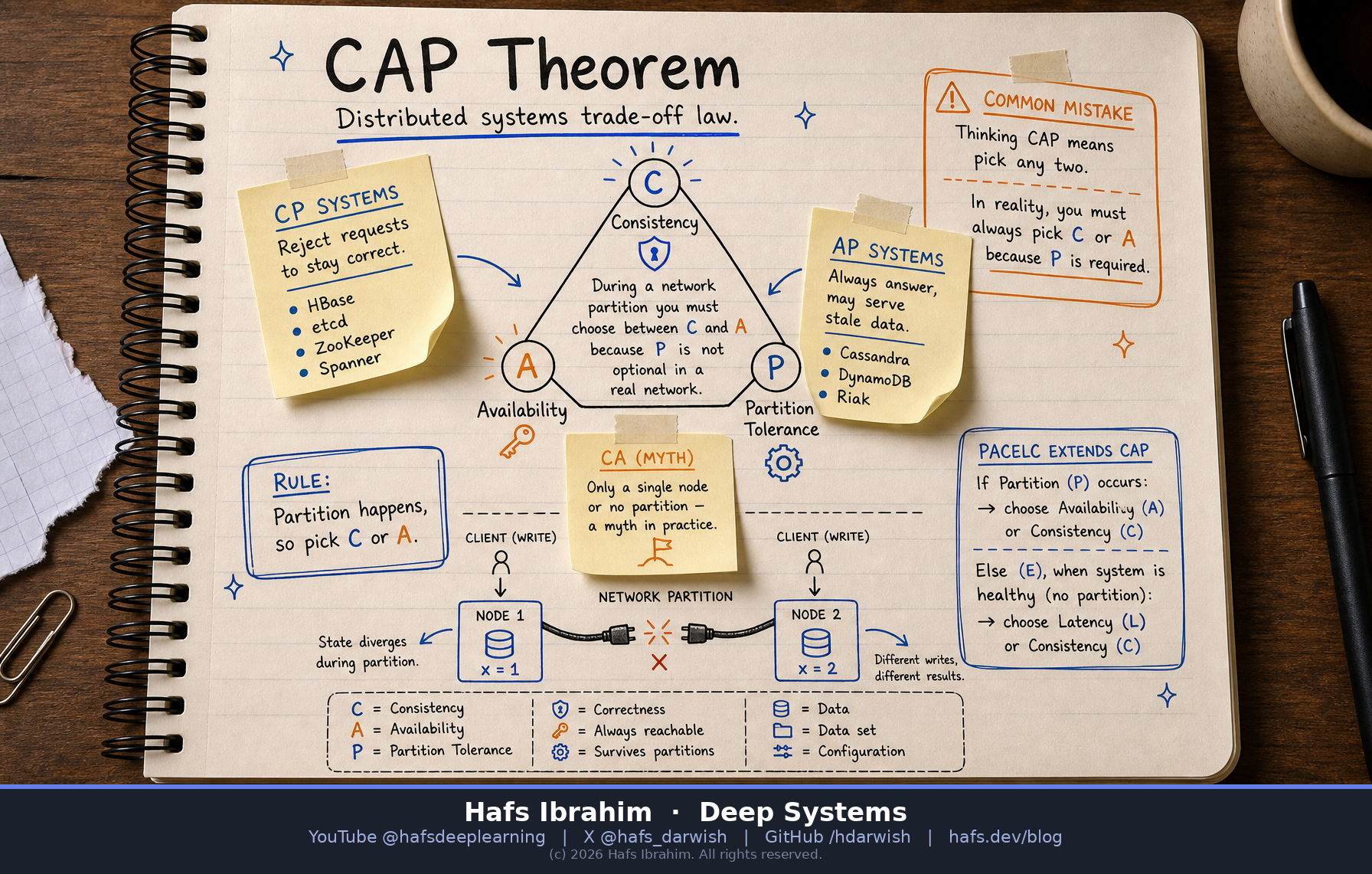
Core Concept
In a distributed data store, when the network between nodes drops messages — a partition — you cannot simultaneously keep every read consistent (all nodes agree on the latest write) and keep the system available (every request gets a non-error answer). You must sacrifice one.
The name misleads people into "pick two of three." That is wrong. Partition tolerance is not a design choice — packets get dropped, cables get cut, switches reboot. P is a fact of the world. So the real theorem is much narrower and much more useful: during a partition, choose consistency or availability. When the network is healthy, you can have both.
Key Components
Consistency
Every read returns the most recent write, or an error. This is linearizability, not the "C" in ACID — it means the cluster behaves like one single copy of the data.
Availability
Every request to a non-failed node returns a non-error response — in bounded time. Note it says a response, not a correct one.
Partition Tolerance
The system keeps operating when arbitrary messages between nodes are lost. Not optional in any real multi-machine deployment.
PACELC
If Partition → choose A or C; Else (normal operation) → choose Latency or Consistency. This captures the daily trade-off CAP ignores.
How It Works
- Two nodes, one datasetNodes N1 and N2 both hold key
x = 1. A client can write to either. So far, so good. - The link failsThe network between N1 and N2 drops. Each node is alive and reachable by clients, but they can no longer talk to each other.
- A write arrives at N1Client A writes
x = 2to N1. N1 cannot replicate it to N2. Now the two nodes disagree. - A read arrives at N2 — the fork in the roadN2 must either return the stale
x = 1(chose availability, broke consistency) or refuse to answer until it can confirm with N1 (chose consistency, broke availability). - Recovery and reconciliationWhen the link heals, CP systems already have one truth. AP systems must merge divergence — last-write-wins, vector clocks, or CRDTs. That merge cost is the price of having stayed up.
| Choice | Behaviour under partition | Real systems |
|---|---|---|
| CP | Rejects or blocks writes on the minority side; needs quorum to proceed | etcd, ZooKeeper, HBase, Spanner |
| AP | Accepts reads and writes everywhere; reconciles later | Cassandra, DynamoDB, Riak, Couch |
| CA | Only coherent on a single node or a network that never partitions | A single-box RDBMS — not a distributed choice |
Real-World Applications
QUORUM reads and writes behaves CP-ish for that query; MongoDB with readConcern: local behaves AP-ish. The tuning knob is where the real engineering lives.Checkpoint — answer before you move on
- Why is "pick any two of C, A, P" a misreading of the theorem? Hint: which of the three is a property you choose, and which is a property of the network?
- A client writes
x=2to one side of a partition, then readsxfrom the other side. Describe exactly what a CP system does and what an AP system does — and what each one costs you. Hint: one answer is an error or a hang; the other is a stale value plus a merge problem later. - What does PACELC add that CAP leaves out, and why does that addition matter more on a normal day than CAP does? Hint: how often is your network actually partitioned versus how often you pay for a quorum round-trip?