Bloom Filters
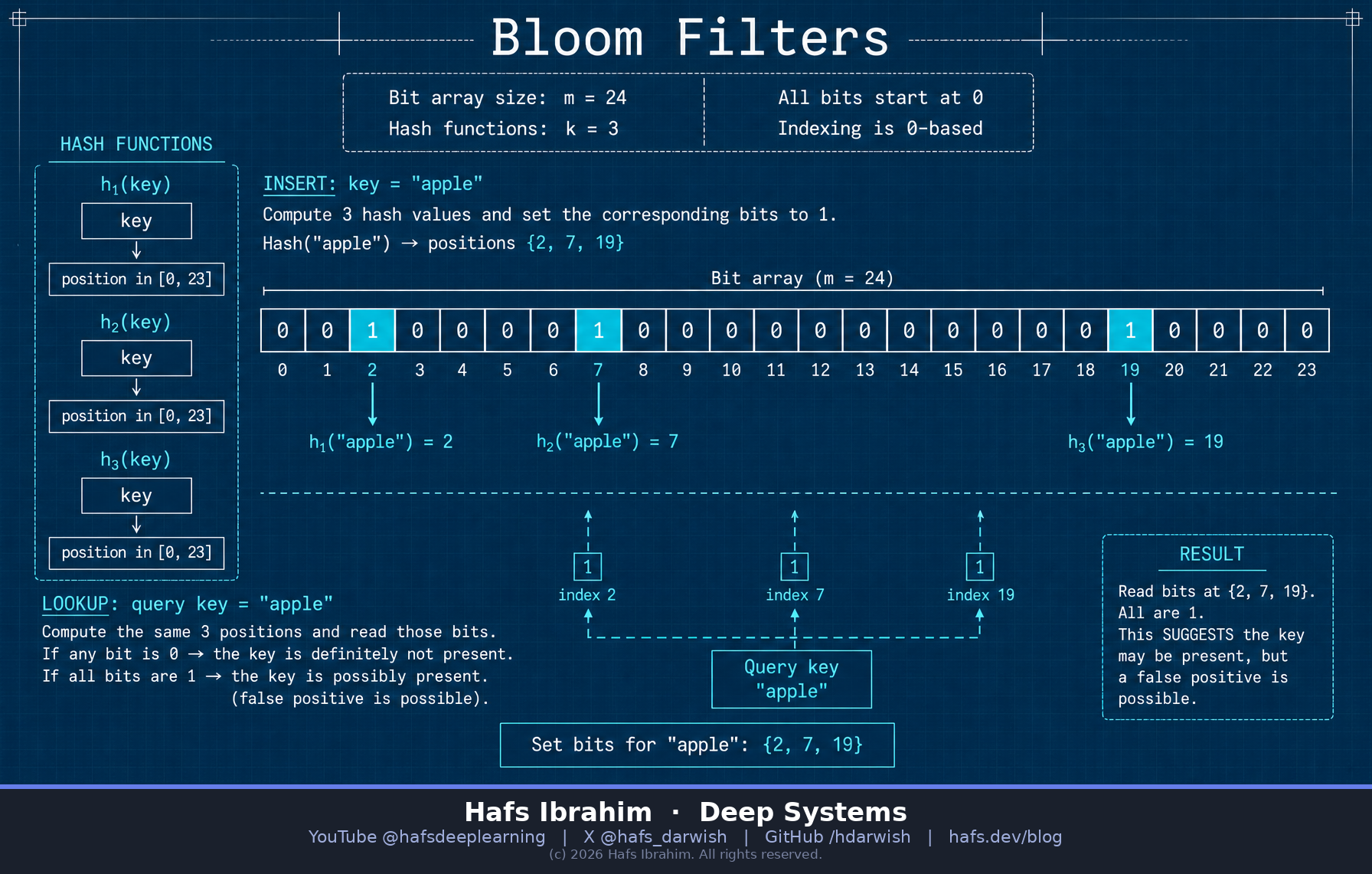
Core Concept
A Bloom filter trades certainty for space. Instead of storing the items themselves, it stores a fingerprint of them in a fixed bit array — then answers one question only: is this item in the set?
Its answers are asymmetric, and that asymmetry is the whole design. “No” is always true. “Yes” means probably — there is a tunable chance it is lying. You accept that lie because the filter costs roughly 10 bits per item regardless of whether the item is a 12-byte ID or a 4 KB URL, and it never touches disk.
The mental shift: a Bloom filter is not a container. It is a cheap gatekeeper in front of an expensive lookup. Every “no” it returns is a disk read, a network call, or a database query you never had to make.
Key Components
Bit array of size m
All zeros at birth. The only storage there is. Larger m → fewer collisions → fewer false positives.
k independent hash functions
Each maps an item to one position in [0, m). Must be fast and well-distributed — MurmurHash, xxHash, not SHA-256.
Insert: set k bits to 1
Hash the item k times, set each bit. Bits are never cleared, so a bit may be shared by many items.
Query: test k bits
Any probed bit is 0 → certainly absent. All k bits are 1 → probably present. That is the entire API.
How It Works
- Allocate m bits, all zero, and fix k hash functions.
- Insert “apple”: compute h₁, h₂, h₃ → positions 2, 6, 11. Set those three bits to 1.
- Insert “bread”: positions 6, 9, 14. Bit 6 is already 1 — leave it. Bits are shared; that sharing is the source of both the space saving and the error.
- Query “grape”: positions 3, 6, 11. Bit 3 is 0 → if it had ever been inserted, that bit would be 1. Answer: definitely not present. No false negatives, ever.
- Query “mango”: positions 2, 9, 14 — all three happen to be 1, set by other items. The filter says “probably present” and it is wrong. This is a false positive, and it is not a bug: it is the price on the receipt.
The Two Equations That Size It
p ≈ ( 1 − e−kn/m )k
k = (m / n) · ln 2 ≈ 0.693 · m/n
m = − ( n · ln p ) / (ln 2)2
Read these as a dial, not as theory. n is how many items you expect; p is the lie rate you can tolerate. Pick p, get m. A 1% false positive rate costs about 9.6 bits per item with k = 7 — roughly 1.2 MB for a million items, versus tens of megabytes to store the keys themselves.
Note what is absent from the formulas: the size of the items. A Bloom filter over a million 2 KB URLs costs the same as one over a million integers.
What It Guarantees — And What It Won't
| False negatives | Impossible. If it says no, it means no. |
| False positives | Possible, at a rate you choose in advance. |
| Deletion | Not supported. Clearing a bit could erase another item's evidence. Use a counting Bloom filter (counters instead of bits) or rebuild. |
| Enumeration | No. You cannot list what's inside — the items were never stored. |
| Resizing | No. m and k are fixed at creation. Exceed n and p degrades fast. Use a scalable Bloom filter for unknown n. |
| Union of two filters | Yes, bitwise OR — if m and k match. |
Real-World Applications
Use It When
✓ The expensive path is a miss you'd like to avoid — disk, network, or a cold database.
✓ Most queries are for items that are absent (that's where the win compounds).
✓ A wrong “yes” costs you only one wasted lookup, not a wrong result.
✗ Skip it when you need deletions, exact answers, the ability to list members, or when n is unknown and unbounded.
Checkpoint — answer before you move on
- Why can a Bloom filter produce false positives but never false negatives? Trace what a probed 0 bit proves, and what a probed 1 bit fails to prove.
- You must support deletion. Explain precisely why clearing the k bits is unsafe, and what a counting Bloom filter changes to make it safe. Think about a bit that two different items both set.
- You expect n = 1,000,000 items and can tolerate p = 1%. Roughly how many bits and how many hash functions do you need — and what happens to p if 4 million items arrive instead? Use m = −n·ln p / (ln 2)² and k = (m/n)·ln 2, then re-evaluate p at the new n.