The Copy That Does Not Happen Until You Write
fork() on a 2 GB process returns in under a millisecond, and what you pay for it later.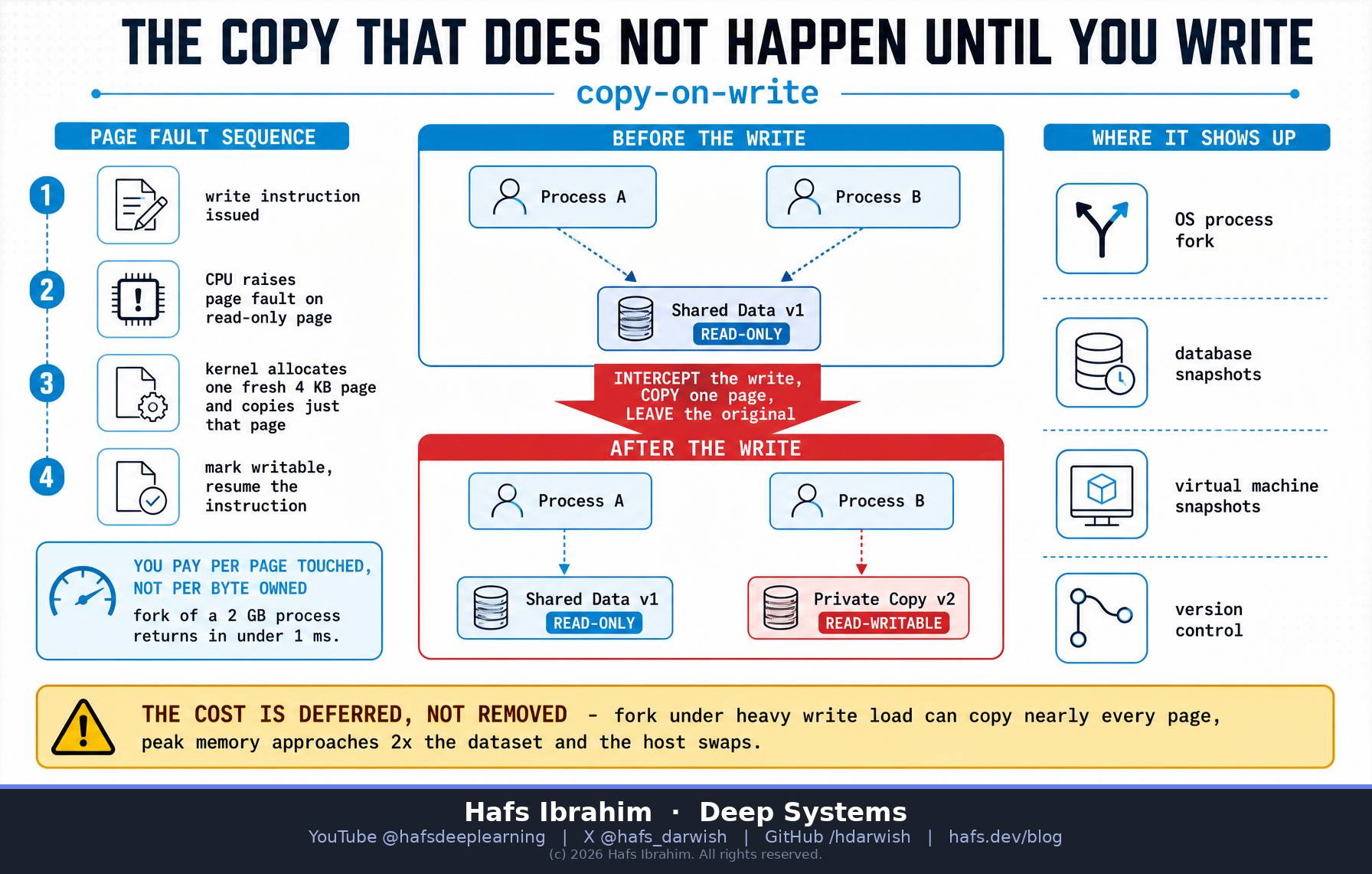
Core concept
Several processes share one instance of the data instead of each getting a private copy. The duplicate is created at the exact moment a process tries to modify it — not a moment sooner.
Underneath the friendly word “copy”: only the page table is duplicated, not the pages. Both processes point at the same physical frames, every shared page is marked read-only, and the copy is instant regardless of size. You pay per page touched, not per byte owned.
Key components
Duplicated page table
Two sets of virtual → physical mappings over one set of physical frames. Cheap, small, O(mappings) — not O(bytes).
Read-only marking
Every shared page loses its write permission. That flag is the whole enforcement mechanism — there is no bookkeeping thread watching you.
Page fault on write
The CPU traps the write instruction mid-flight and hands control to the kernel. The instruction has not committed yet, so it can be resumed.
One 4 KB page
The kernel copies a single page, flips it writable for the writer only, and leaves everyone else on the original. Cost scales with pages written.
How it works — intercept, copy, leave the original alone
- A process issues a write to a shared, read-only page.
- The processor raises a page fault — the write is intercepted before it lands.
- The kernel allocates one fresh 4 KB page and copies just that page’s contents.
- It remaps the writer to the new page and flips it to writable.
- The faulting instruction resumes. Every other process still sees the original, untouched.
Where it shows up
- Operating systems —
fork(). Duplicating a 2 GB process returns in well under a millisecond, because nothing was actually copied yet. - Database & filesystem snapshots. ZFS and Btrfs snapshot instantly by sharing blocks and diverging only on write.
- Virtual machines and VM snapshots. Boot many VMs off one base image; each one only materialises the pages it dirties.
- Version control & background saves. Redis forks a child to write its snapshot to disk while the parent keeps serving traffic.
⚠ Falsification — test this before you trust it
The cost is deferred, not removed, and it arrives as latency at the worst possible moment.
A Redis instance that forks to save while write traffic is heavy can end up copying nearly every page anyway. Peak memory approaches double the dataset and the host starts swapping — the “free” copy becomes the most expensive operation of the day.
The experiment: fork under a write-heavy load and watch resident set size climb, rather than assuming the copy stayed free. If RSS tracks toward 2× your dataset, you have found the deferred bill.
Checkpoint — answer before you move on
- A process holding 2 GB calls
fork()and returns in under a millisecond. What was actually duplicated, and what was not? Hint: name the structure that was copied, and what makes the pages themselves safe to share. - Nothing watches for writes, yet the write is caught. Trace the exact sequence from the write instruction to its resumption. Hint: five beats — permission flag, hardware trap, allocation size, remap, resume.
- Your Redis host has 8 GB of RAM and a 5 GB dataset, and it swaps every time a background save runs. Why, and what measurement would confirm it? Hint: what happens to shared pages when the parent keeps taking writes during the save?