How to Lose an Argument and Still Ship on Monday
The real name for it: disagree and commit — a decision rule, not a personality trait.
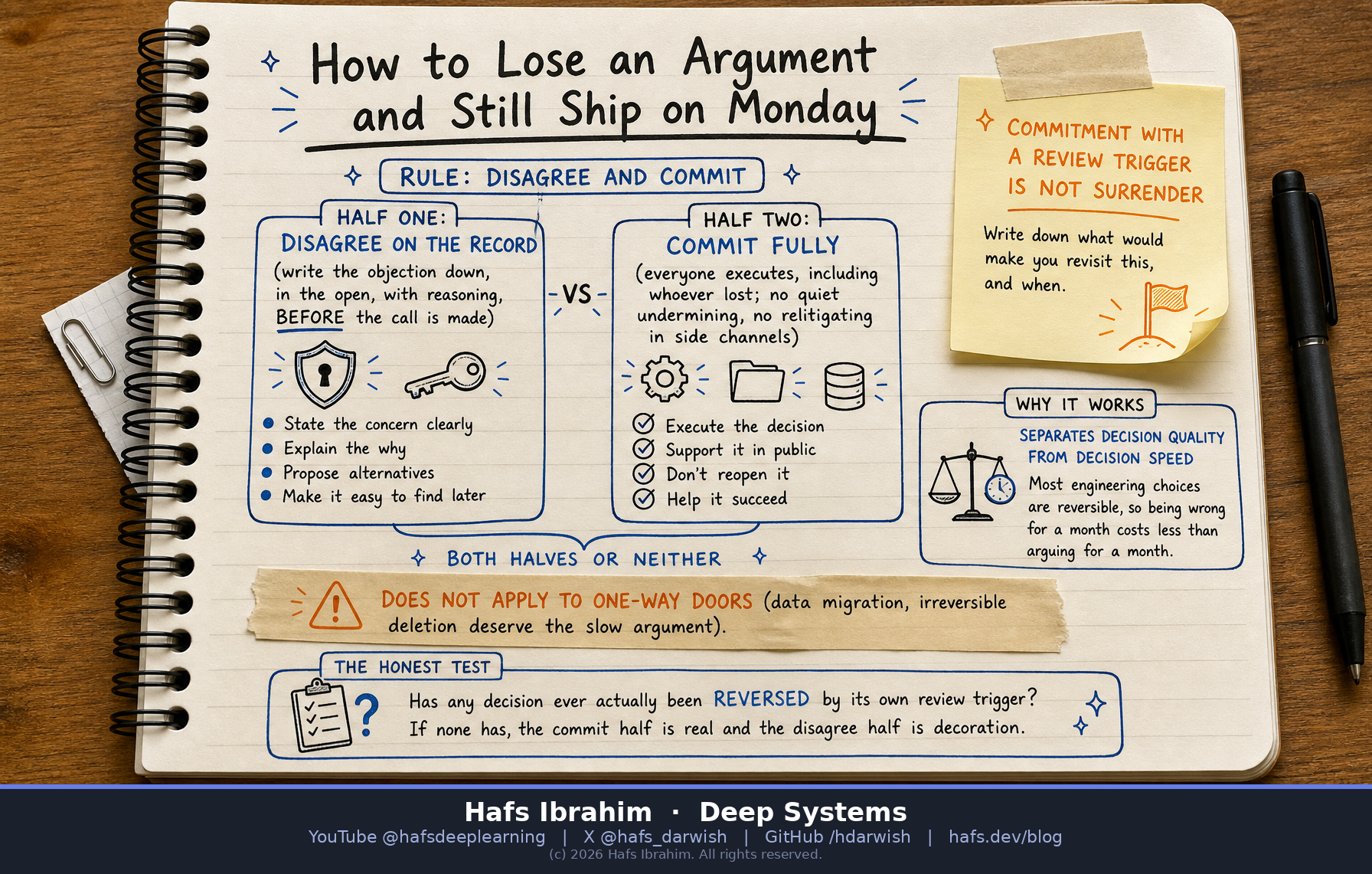
Core Concept
Disagree and commit is a decision rule with two halves, and it only works when both are present. First: your disagreement gets recorded before the decision — in the open, with the reasoning, and genuinely heard. Second: once the call is made, everyone executes it fully, including the people who lost, with no quiet undermining and no relitigating in side channels.
What the rule actually buys you is a separation most teams never make: it splits the quality of a decision from the speed of it. Most engineering choices are reversible. Being wrong for a month costs far less than arguing for a month.
The Two Halves
Disagree, on the record
Written down before the call, in the open, with reasoning attached. Not vented in a DM after the fact.
Commit, completely
Execute as if you had won. No slow-walking, no side-channel relitigating, no "I told you so" scaffolding.
Half one alone is a debating society. Half two alone is obedience. The pairing is the whole mechanism — and the thing that makes commitment safe is naming, in writing, what would make you revisit the decision, and when. A commitment with a review trigger is not surrender.
Key Components
Recorded dissent
The objection exists as an artifact with reasoning, dated before the decision. Unwritten disagreement cannot be honoured later.
Full execution
The losing side ships the winning design at full effort. Partial commitment guarantees the outcome you predicted.
Review trigger
A written condition and date that reopens the decision. This is what converts "commit" from surrender into a bounded bet.
Reversibility check
Two-way door → decide fast and commit. One-way door → the slow argument is the correct cost.
How It Works
- Surface the disagreement before the call. Write the objection and its reasoning where the decider can read it. Verbal-only dissent does not count — it cannot be revisited.
- Check which kind of door this is. Reversible? Optimise for speed. Irreversible — a data migration, a deletion, a public API contract — and the rule does not apply.
- Make the call, and name it as made. Ambiguity about whether a decision happened is what generates the side-channel relitigating later.
- Write the review trigger. "We revisit this if p99 latency exceeds X by date Y." Now the dissenter has a real mechanism instead of a grudge.
- Execute fully, then actually run the trigger. The trigger is the honest part. An unrun trigger means the disagree half was decoration all along.
Where It Breaks — Falsification
Real-World Applications
- Architecture calls. Two viable databases, a week of debate, a reversible choice. Record the objection, pick one, set a trigger on the metric the loser is worried about.
- Code review deadlock. Both patterns work. The reviewer states the concern in the thread, the author ships, and the concern becomes a follow-up issue rather than a stalled PR.
- Product scope under a deadline. Engineering wants the refactor, product wants the ship date. Written dissent plus a dated revisit beats a fortnight of escalation.
- What it must never cover. Deleting production data, a schema migration with no rollback, a contract you have published to customers. Slow argument, on purpose.
- Your own learning decisions. Pick the course, commit for four weeks, and write the condition that would make you switch. Otherwise you re-choose weekly and finish nothing.
Checkpoint — answer before you move on
- Both halves of the rule are required. Which half is missing when a manager says "we've discussed enough, let's disagree and commit" in the meeting where the topic first came up? Hint: think about the ordering requirement, not the sentiment.
- Explain why the rule's cost argument stops holding for a one-way door such as an irreversible data deletion. Hint: the justification compares the cost of being wrong for a month against the cost of arguing for a month.
- Your team has used disagree-and-commit for a year and no decision has ever been reversed. What does that measurement tell you about the process? Hint: which half of the rule is doing real work, and which one is decoration?